Play Leveling and Advancement
Advancement Procedure – Skill, Challenge, Performance.
Overview
The Tellico Village Pickleball Club uses a player rating system based on the IPTPA rating system. Player ratings for our club are 2.0, 2.5, 3.0, 3.5, and 4.0. After orientation or Level Placement evaluation, players are assigned an initial skill level.
Players trying to move from 2.0 to 2.5 will be assessed during 2.0 Skills & Drills.
Players at 2.5 level or above wishing to level up will need to go through a more formal evaluation process. That process is described here.
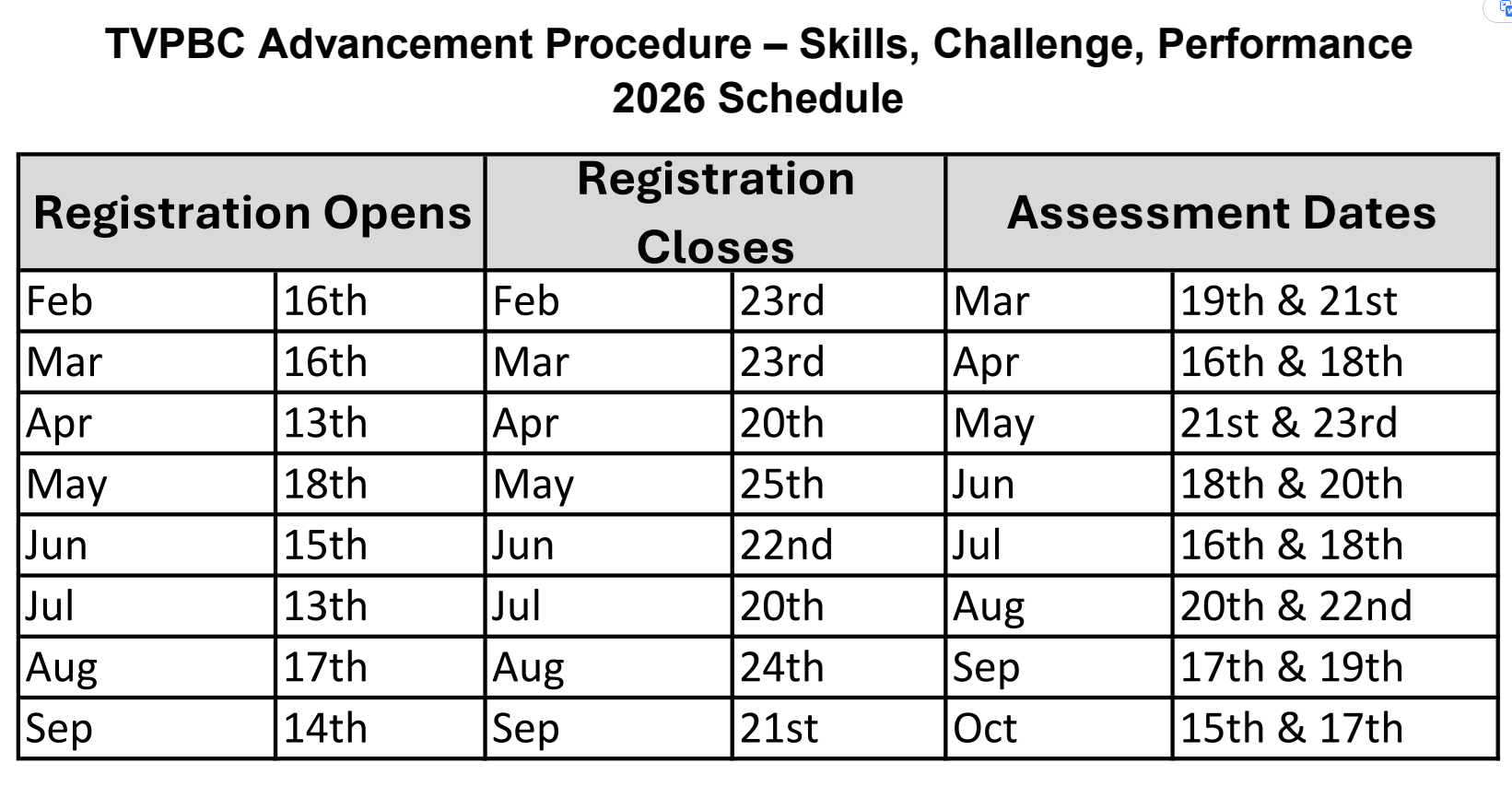
Evaluations are held on the 3rd Thursday and Saturday of the month, from March through October. A maximum of 8 candidates for each skill level can be evaluated each month.
The Evaluation Process
For new players who already have experience playing, and/or a rating from another club, skip down to level placement.
NOTE: A Parks & Recreation membership or guest pass is required for evaluations.
Evaluations for players advancing to 3.0 or above consist of 2 phases, as defined below. For players advancing from 2.0 to 2.5, you will be evaluated at 2.0 Skills & Drills.
Phase 1 – Skills Assessment
Skills assessment is based on the IPTPA rating system. You will be assessed on your ability to perform different shots accurately. A feeder will feed you balls which you will hit to designated areas on the court.
Below are diagrams of the various shots, showing how the ball is fed, feeder position, player position, and where on the court your shot should land.
There is time allocated on the club’s court schedule for an evaluation clinic that runs from March through October. Be sure to look for it on the court schedule. In the clinic you will learn exactly how the skills assessment portion of the evaluation works. Evaluation clinic is held on the 2nd and 4th Monday of the month.
Phase 2 – Ghost Doubles
In the ghost doubles segment of the evaluation, you will play 3 games of ghost doubles against a player who is already at the level you wish to advance to. Ghost doubles is a one on one game, played “skinny”. Scoring is rally scoring, games to 11, win by 1.
For more of an explanation on ghost doubles, you can check out the following link.
Explanation of Skinny Singles and Ghost Doubles
The club also allocates court time on the court schedule for ghost doubles practice (March through October), and there are sub-clubs in Pickleball Den set up for mixed-level ghost doubles practice. These are great resources for practicing ghost doubles and can give you an opportunity to practice against higher-level players. Ghost doubles practice is held on the 1st, 3rd, and 5th Monday of the month. Courts 9 & 10 are for 2.5/3.0 level; courts 11 & 12 are for 3.0/3.5 level. No sign up is needed for these practice sessions.
In addition to the court time reserved for ghost doubles practice, there are sub-clubs in Pickleball Den for additional practice that you can join. Those clubs require sign ups.
How to Begin the Evaluation Process
Step 1 - Review the Required Skills
The first step is to review the skills self-assessment sheet for the level you want to be promoted to. Be sure to review it before starting the evaluation process.
2.0 Skill Knowledge
- Knows some of the basic rules such as two bounce rule and scoring
- Demonstrates a forehand stroke
- Demonstrates a backhand stroke
- Demonstrates a volley
- Demonstrates an overhead shot with some force
- Gets some serves into the correct service square
- Knows where to stand as the serve team and the return team
- Has some mobility, moving in a safe and balanced manner
- Watches the ball and may communicate with partner
- May try to hit some dinks
- Knows to come up and play close to the NVZ
- Consistency Goal: Hit 3 shots in a row without making an unforced error
2.5 Skill Level- Should also possess all 2.0 skills
- Knows the basic rules including two bounce rule, scoring and player position relative to scoring
- Demonstrates basic pendulum swing on the forehand & backhand side
- Working on consistency while dinking down the line forehand & backhand
- Working on consistency while dinking cross court forehand & backhand
- Demonstrates proper side step movement while staying balanced at NVZ line
- Demonstrates a punch volley
- Is developing 3rd shot drop by long dinking from the transition area
- Attempting to hit 3rd shot drop during match play on the short court
- Moving forward to approach NVZ for dinks & volleys
- Demonstrates an overhead with the proper sideways turn, arm positioning and backward movement
- Has good mobility and can move forward in a safe and balanced manner
- Has good eye-hand coordination
- Beginning to demonstrate control on forehand groundstrokes (direction, depth, height)
- Uses a backhand ground stroke
- Keeps ball in play during short rallies
3.0 Skill Knowledge - Should also possess all 2.5 skills
- Attempting to consistently dink while changing directions from cross court to down the line forehand & backhand
- Does not back up unnecessarily from NVZ
- Punches volley to the back ½ of opponent court
- Sustains a short volley exchange at the net
- Can perform 3rd shot drop by long dinking from the transition area
- Using 3rd shot drop during match play on the short court
- Moving forward as a team to approach NVZ for dinks & volleys
- Can perform an overhead with better control while maintaining proper position
- Has good mobility & quickness
- Demonstrates improved control on forehand groundstrokes (direction, depth, height)
- Better control on backhand groundstrokes
- Keeps ball in play during short rallies
- Attempts offensive lobs during play
- Demonstrates placement & depth on serves
- Demonstrates placement & depth on return of serves
- Attempting to adjust to different ball speeds (serves, groundstrokes, volleys)
3.5 Skill Level - should possess all 3.0 skills
- Can consistently dink while changing directions from cross court to down the line forehand & backhand
- Punches volley to the back ½ of opponent court, to keep opponents at the baseline
- Sustains a controlled volley exchange at the net
- Performs 3rd shot drop from the baseline
- Is beginning to dink with a purpose
- Moving forward as a team to approach NVZ for dinks & volleys
- Developing directional control while performing an overhead
- Demonstrates control on forehand groundstrokes (direction, speed, depth, height)
- Demonstrates control on backhand groundstrokes (direction, depth, height
- Keeps ball in play during rallies and is aware of minimizing errors
- Able to communicate effectively with partner & utilize different strategies to expose opponent weaknesses
- Using deeper and higher returns to approach the net quicker
- Uses offensive lobs effectively
- Demonstrates better placement and depth on serves
- Demonstrates better placement and depth on return of serves
- Improved control when adjusting to different ball speeds (serves, groundstrokes, volleys)
4.0 Skill Level - Should also possess all 3.5 skills
- Sustains a volley exchange at the net and beginning to use directional control
- Can demonstrate a block volley
- Able to hit winning volley when a ball is popped up
- Better consistency when performing 3rd shot drop from the baseline
- Can hit 3rd shot drop from baseline during match play with greater success
- Moves effectively with partner, easily switching sides, and communicates when required
- Controls play at the NVZ line, by keeping their opponent back if they’re at the baseline
- Dink with a purpose to elicit a put away shot
- Can demonstrate an effective poach, and understands when it’s appropriate
- Able to change a fast paced strategy to a slow one and vice versa
- Can consistently perform an overhead and beginning to place the shot for winners
- Demonstrates control on forehand groundstrokes (direction, depth, height, spin)
- Demonstrates control on backhand groundstrokes (direction, depth, height)
- Understands proper shot selection to minimize errors
- Able to adjust to differing ball speeds consistently
- Uses offensive lobs effectively
- Beginning to use spin effectively on a variety of shots
- Maintains greater patience in dinks & rallies
- Beginning to anticipate shots more frequently (watching opponents paddle face)
Step 2 - Print and Complete the Skills Self-Assessment Form
- Review the form and answer each skill as to your competency.
- Sign and date the form
- Submit the form via email to the Evaluation Director by the 1st Sunday of the month for the next evaluation period. See the schedule below.
Step 3 - Join the Evaluation Sub-Club on Pickleball Den
Join the Pickleball Den evaluation sub-club for the level you want to be promoted to. When registration opens, you will receive an email from the evaluation director to sign up for the evaluation. The calendar at the end of this page lists the dates that registration opens. Please note that you will not be notified unless you join the evaluation sub-club for your level.
See how to join a sub-club in Pickleball Den for more information.
Step 4 - Sign up on the Pickleball Den signup sheet
Sign up using the Pickleball Den signup sheet for the next evaluation.
ONLY SIGN UP for YOURSELF. DO NOT sign up any other player, including if it’s a spouse or significant other. Each player must sign up for themselves.
When you receive notification from the Evaluation Director, be sure to sign up on Pickleball Den to save your spot. Sign ups tend to fill up fast, so if you don’t sign up right away, you may be wait listed. There is a limit of 8 players per skill level. See how to sign up for an event for more information.
Once you sign up, you will receive an email from an E-Team member requesting your availability for day and time.
On the Day of Your Evaluation
IMPORTANT – If you do not come prepared or know what is expected, the Coordinator(s) have the right to disqualify you from completing the assessment.
Checklist:
- Come to the Pavillion (courts 9-12) 15 minutes early from the time assigned to you.
- Check in with the the E-Team to learn whether you will complete the skills assessment first or ghost doubles first.
- BE WARMED UP! You will not have warm up time at the assessment, and no E-Team member or ghost doubles challenger will be allowed to warm you up.
Skills Assessment
For the skills assessment portion of your evaluation, you will be informed about what is expected for each part of the assessment. There will be a person feeding the balls to you, and 2 referees making line calls and keeping track of your score. The referees will also be looking for faults such as illegal serves and NVZ foot faults.
Ghost Doubles
For the ghost doubles portion of your evaluation, you will play 3 games of ghost doubles against a player who is at the level you wish to be promoted to. Games are rally scoring to 11, win by 1. You will serve first, and choose which side of the court you want to play on. There will be 2 referees making line calls and keeping track of the score. You can call time out at any time, and there is no limit to the number of time outs you take.
Be aware that the referees will be looking for faults such as illegal serves and NVZ foot faults.
Please note that the evaluators will not be able to tell you whether you’ve been promoted. However, you can request your scores for both the skills assessment and ghost doubles.
After Evaluation
The Evaluation Director will email you to confirm your promotion or provide feedback for why you have not been promoted.
If you are not promoted, you must wait 60 days before being evaluated again.
The Evaluation Director will send a list of those being promoted to the Treasurer and IT Director to update the member list.
If you are promoted, you must wait a full 120 days prior to attempting next level promotion.
Level Placement
“Level Placement” ; will be used when a player is new to Tellico Village and already has experience playing and/or a rating from another location/club.
- Obtain a Parks and Recs Membership and Pickleball Club membership and notify Evaluations Director. This is required if a person requests a Level Placement session vs. an Orientation Session.
- Contact the Evaluation Director via e-mail with your name, email, phone number, and current rating (if you have one).
- Complete a Self-Assessment sheet for the level you feel you play at and send to the Evaluation Director. If you have a rating, provide copy of your USAPA/PPA/IPTPA or other rating if they have such.
- After a review the Evaluation Director will suggest a provisional level, and you will be allowed to play at the provisional level and combined level below sessions only.
- The Evaluation Director will coordinate a one-on-one assessment and only then will a current TVPBC level be determined, communicated and updated on the roster of the software platform used by the club. An email will be sent to the players in that level as an introduction.
Contact the Evaluation Director for more information.